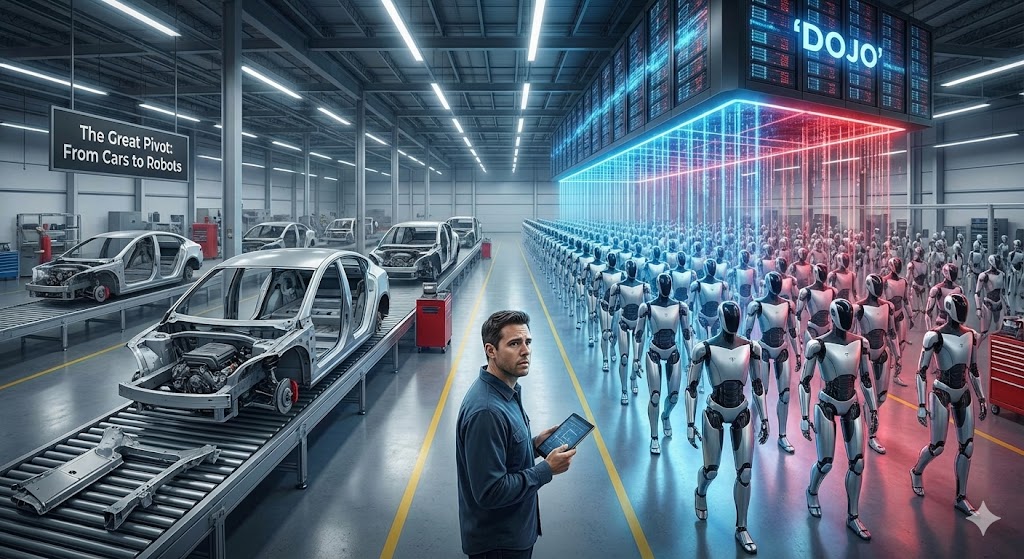
1. The End of an Era: What Happened?
In early 2026, Tesla announced the discontinuation of its flagship models, the Model S and Model X.
While these vehicles played a critical role in establishing Tesla’s premium EV identity, recent sales data suggests that they now represent a small fraction of total deliveries compared to the Model 3 and Model Y.
According to Tesla’s recent earnings disclosures, Model 3/Y account for the overwhelming majority of annual global deliveries. This strategic realignment reflects changing market priorities rather than declining brand strength.
2. Fremont Factory Repurposing: From Cars to Robots
Tesla plans to repurpose portions of its Fremont, California facility into a mass-production hub for Optimus, its humanoid robot platform.
This move signals a capital reallocation strategy:
- Manufacturing space optimization
- Engineering talent concentration
- Long-term AI infrastructure investment
Rather than diversifying product lines, Tesla appears to be consolidating around scalable platforms with higher projected growth potential.
3. Cars as AI Training Platforms
Tesla vehicles function as data-collection systems.
Each car generates real-world driving video used to train Full Self-Driving neural networks. Unlike purely digital AI systems, Tesla’s AI benefits from:
- Billions of real-world driving miles
- Vision-based neural network training
- Edge-computing optimization
From a technical perspective, a vehicle equipped with FSD can be conceptualized as a mobile robotics platform.
The same perception and motion-planning architecture required for urban navigation is foundational for humanoid robotics operating in structured human environments.
4. Industrial Implications: Automotive to Robotics Transition
This shift represents a broader transformation:
| 2012–2022 | EV Manufacturing | Premium Sedans/SUVs | Automaker |
| 2023–2025 | Mass EV Scaling | Model 3/Y | Mobility Platform |
| 2026– | Robotics & AI | Optimus + AI Systems | AI Infrastructure Company |
Tesla’s identity is transitioning from automotive manufacturing toward AI-enabled physical systems.
5. Safety and Regulatory Considerations
As a researcher in mobility safety and data-driven transport systems, it is clear that large-scale robotics deployment introduces new policy challenges:
- Liability frameworks
- Fail-safe system requirements
- Physical AI governance
- Human override protocols
The conversation should focus not on speculative scenarios, but on:
- Regulatory preparedness
- Standardized testing frameworks
- International safety harmonization
6. Strategic Risk and Opportunity
Tesla’s decision is high risk but internally consistent:
- Reduce low-volume legacy models
- Redirect resources toward scalable robotics
- Leverage proprietary AI datasets
If successful, the addressable market for industrial and domestic robotics could exceed traditional automotive margins.
However, technological acceleration must be matched by institutional oversight.
Conclusion
The discontinuation of the Model S and Model X marks more than the retirement of two vehicles. It represents a structural pivot toward robotics and AI infrastructure.
The next chapter for Tesla will not be defined solely by vehicle sales, but by its ability to translate automotive AI into scalable physical intelligence systems — while maintaining robust safety and governance standards.